
As if the chaos described in Episode 1, was not enough, borrowing of library materials that were not in the library catalog was recorded on paper. This would be less than optimal normally, but the information that was written down included the title and ISBN of the item, but no unique barcode number. It is nearly impossible to know if a book has been returned unless it is the ONLY copy of that title that the library has. Of course, most of these items were not unique. Also, no follow up was done at the end of the academic year to make sure everything was returned, even from graduates.
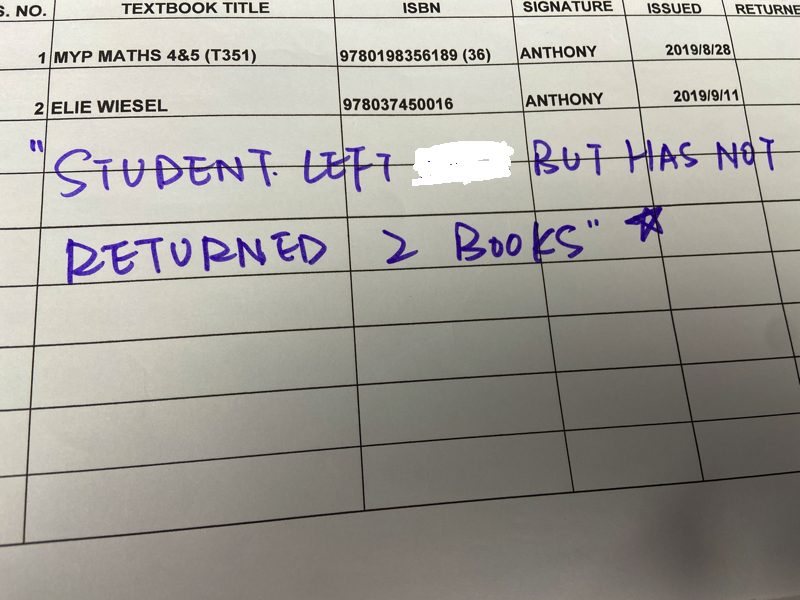
To make this more difficult, the institution is subject to government regulations that require the strict accounting for every book. Any book damaged or lost must be replaced or paid for by the responsible party. These paper check outs cannot just be written off.
There is also a challenge in providing a way for these books to be paid for. Parents, especially those who have left the city, will want to pay online. Cash-in-person is an option for others, but that means the library staff now needs to accept, record, and store money. All funds received have to be carefully recorded and applied to purchasing books. It is more complicated than it sounds.
I am currently working on drafting the message to be sent to parents of students who have left without returning books. Once approved by my line manager, I will have to send separate emails with specific details to each of those parents. Then I will have to draft a separate message to parents of current students, as the payment details will be different. And, again, type up separate emails to each. So time consuming. I also expect that there will be irritated responses from some of the parents and claims that the items were returned, which I cannot verify due to the vagueness of our records. If only the unique barcode number on each book had been written down.
Let’s talk about Asset Management. The school is audited at least once per year. Auditors come into the campus to make sure that we have the assets that we are supposed to have with minimal loss. Assets cannot be discarded until after 7 or 8 years after acquisition (although this is vague and I have not seen it in writing.) Broken furniture must be kept, although stored. Despite the consumable nature of books, they are considered long-term assets. Therefore, damaged/worn/outdated books must be kept.
The auditors use barcode stickers to accomplish this stock taking task. If a replacement book is received, I need to put the same barcode number on the new copy in order to match the auditor’s records. Unfortunately, in a previous audit, duplicate barcode numbers were applied to completely unrelated books. Rarely, two barcodes were applied to a single book. I have found books that clearly have been in the library for a long time, but they have no audit barcode at all. It is a less than accurate system.
One of the first tasks I delegated to a volunteer was to remove damaged books from the shelves. There are a lot of them and we continue to find more in daily borrowing of books. Broken spines, water damage, mildew, and cellophane tape. Pop-up books are always so worn out that they are an automatic removal. No one should buy pop-up books for a library collection. I wish that I could move all the existing books into storage and start fresh with all new books. It would be less time consuming.

 International School Librarian